The court scholar serving Hermann of Thuringia.

The court scholar serving Hermann of Thuringia.
The scholar

2009/01/29

President's TV interview with al Arabiya

President Obama's first television interview was with the station al-Arabiya (The comedian Jon Stewart did a "startled" double-take on "learning" that Obama's first interview was primarily aimed at a foreign audience), and it contained some very refreshingly realistic views:

"[Peace between Israel & Palestine is] going to be difficult, it's going to take time. I don't want to prejudge many of these issues, and I want to make sure that expectations are not raised so that we think that this is going to be resolved in a few months. But if we start the steady progress on these issues, I'm absolutely confident that the United States -- working in tandem with the European Union, with Russia, with all the Arab states in the region -- I'm absolutely certain that we can make significant progress.going to be difficult, it's going to take time. I don't want to prejudge many of these issues, and I want to make sure that expectations are not raised so that we think that this is going to be resolved in a few months. But if we start the steady progress on these issues, I'm absolutely confident that the United States -- working in tandem with the European Union, with Russia, with all the Arab states in the region -- I'm absolutely certain that we can make significant progress."


Obama made it clear here "I'm not G. W. Bush, I'm not going to make wildly unrealistic promises" and also, that the US is not going to try and solve this problem all by itself. Many other actors will be called in to assist.

Some realistic talk here:


"Now, Israel is a strong ally of the United States. They will not stop being a strong ally of the United States. And I will continue to believe that Israel's security is paramount. But I also believe that there are Israelis who recognize that it is important to achieve peace. They will be willing to make sacrifices if the time is appropriate and if there is serious partnership on the other side."

Meaning let's not let those who are sympathetic to the Palestinians get carried away with enthusiasm. Yes, this President is more realistic than the last one was, but only in a relative sense.

Still, this is an encouraging promise:


"I think it is possible for us to see a Palestinian state -- I'm not going to put a time frame on it -- that is contiguous, that allows freedom of movement for its people, that allows for trade with other countries, that allows the creation of businesses and commerce so that people have a better life."

Obviously, "contiguous" means only as far as the West Bank is concerned and no mention is made as to how to deal with Israeli settlements. Does "
freedom of movement" mean that the President wants to take down Israeli highways running through the West Bank and dismantle the Israeli checkpoints? It's impossible to say at this point, but this is a reasonably good and hopeful start.


Q: How concerned are you and -- because people sense that you have a different political discourse. And I think, judging by (inaudible) and Zawahiri and Osama bin Laden and all these, you know -- a chorus --

THE PRESIDENT: Yes, I noticed this. They seem nervous.

Q: They seem very nervous, exactly. Now, tell me why they should be more nervous?

THE PRESIDENT: Well, I think that when you look at the rhetoric that they've been using against me before I even took office --

Q: I know, I know.

THE PRESIDENT: -- what that tells me is that their ideas are bankrupt. There's no actions that they've taken that say a child in the Muslim world is getting a better education because of them, or has better health care because of them.

In my inauguration speech, I spoke about: You will be judged on what you've built, not what you've destroyed. And what they've been doing is destroying things. And over time, I think the Muslim world has recognized that that path is leading no place, except more death and destruction.

Now, my job is to communicate the fact that the United States has a stake in the well-being of the Muslim world that the language we use has to be a language of respect.

What Obama is doing here is that he's differentiating "hard" military power from "soft" persuasive power. Judging by their words, al Qaeda appears to recognize that he's got a point, that "soft" power poses a real threat to al Qaeda's ability to act as the savior of the Muslim world.

And again, this sort of language is extremely refreshing after the past eight years:


"But ultimately, people are going to judge me not by my words but by my actions and my administration's actions.
----------
"We're going to follow through on our commitment for me to address the Muslim world from a Muslim capital. We are going to follow through on many of my commitments to do a more effective job of reaching out, listening, as well as speaking to the Muslim world."

As well, this next statement is extremely refreshing after hearing propagandistic nonsense terms like "Islamo-fascism" come from our former President:


Q: President Bush framed the war on terror conceptually in a way that was very broad, "war on terror," and used sometimes certain terminology that the many people -- Islamic fascism. You've always framed it in a different way, specifically against one group called al Qaeda and their collaborators. And is this one way of --

THE PRESIDENT: I think that you're making a very important point. And that is that the language we use matters. And what we need to understand is, is that there are extremist organizations -- whether Muslim or any other faith in the past -- that will use faith as a justification for violence. We cannot paint with a broad brush a faith as a consequence of the violence that is done in that faith's name.

Unfortunately, I have to reduce President Obama's grade for the interview from an "A" to a "B" for the following statement on Iran:


Now, the Iranian people are a great people, and Persian civilization is a great civilization. Iran has acted in ways that's not conducive to peace and prosperity in the region: their threats against Israel; their pursuit of a nuclear weapon which could potentially set off an arms race in the region that would make everybody less safe; their support of terrorist organizations in the past -- none of these things have been helpful.

Iranian politicians have said Israel is a terrible country and that, like the white dominance of South Africa, that the Israeli oppression/occupation of Palestine should simply cease to exist, but it's simply not accurate to say that the state of Iran has officially threatened Israel.

Iran has claimed, though not proven, that it's pursuit of nuclear power is for strictly peaceful purposes. Obama should at least acknowledge this complication and qualify his statement rather than to simply state baldly that Iran is trying to produce nuclear weapons. And as Juan Cole points out:


And the main thing American politicians seem to mean when they accuse Iran of supporting terrorism is that it backs the Lebanese Hizbullah Party, which hasn't done anything that qualifies as international terrorism for a decade at least. (Being a national liberation movement and working against the Israeli occupation of Lebanese territory was not terrorism in international law.) At least, Obama put the 'support of terrorism' clause in the past tense (was he thinking of the 1980s and early 1990s?) and avoided the odd rhetoric of Condi Rice, who branded Iran the biggest supporter of terrorism in the world; wouldn't that be al-Qaeda?

But this was a good ending:


But I do think that it is important for us to be willing to talk to Iran, to express very clearly where our differences are, but where there are potential avenues for progress. And we will over the next several months be laying out our general framework and approach. And as I said during my inauguration speech, if countries like Iran are willing to unclench their fist, they will find an extended hand from us.

A positive review of the interview from Foreign Policy.

YouTubes of interview: one two
2009/01/22

Department of unsurprising news

Item number one - The warrantless wiretapping program that was the cause of about 30 top Justice Department officials (Pretty much the entire upper level of the Justice Department) very nearly resigning in protest and then first revealed to the country at large by the NY Times (An NY Times reporter was about to publish a book on the matter, so the Times had to hurry and beat him to the punch) and was then defended as a very limited program:

[President Bush] "We use FISA still. But FISA is for long-term monitoring. What is needed in order to protect the American people is the ability to move quickly to detect." Then later "There is a difference between detecting, so we can prevent, and monitoring. And it's important to note the distinction between the two."

and:

[CIA-director nominee Gen. Michael V. ] HAYDEN [video clip]: "This is not about intercepting conversations between people in the United States. This is hot pursuit of communications entering or leaving America, involving someone we believe is associated with Al Qaeda."

Well, it turns out that no such distinctions were actually being made. It was a data-mining program where massive amounts of phone calls, emails, faxes and other communications were swept up in huge dragnets and then analyzed using computer software that was looking for keywords and then broken down and analyzed further. Government officials were busy lying to, not just the American people at large, but to any Congresspeople, Senators or any other government personnel who "threatened" to discover just what was going on.

Item number two: The war on the people of Gaza did indeed kill "223 Hamas guerrillas," but also:

the World Health Organization released a report estimating that 1,300 Palestinians were killed during the fighting, including 410 children and 104 women. About 5,300 Palestinians were injured, half of them women and children, the report said.

and some 50,000 Palestinians are now homeless, 400,000 have no access to running water and 21,000 buildings were destroyed.

And what was the world reaction to this?

In addition to allegations of indiscriminate violence, critics accuse Israel of violating international law restricting the use of phosphorus weapons, which can inflict horrific burns. Phosphorus artillery shells and similar weapons are not illegal, but the law bars their use in densely populated areas such as Gaza City, one of the most crowded urban areas in the world.
---------
Chanting "war criminal," hundreds of pro-Palestinian protesters demonstrated against [Israeli Foreign Minister Tzipi] Livni's visit in Brussels.

and:

European attorneys have reportedly petitioned a Belgian court to arrest Foreign Minister Tzipi Livni upon her arrival in Brussels later Wednesday, according to the Jawalan.com Web Site.

Three were killed and eight wounded in a car bomb attack in Baghdad. There is absolutely no question that this attack constituted collateral damage from the war in Gaza.

And for what?


Uniformed Hamas security teams emerged on Gaza City's streets Monday as leaders of the Islamic militant group vowed to restore order...

No, Hamas has not suffered any sort of knock-out blow. Hamas is weakened physically, but that can be fixed quickly and easily. Hamas is now more popular and more legitimate than it was and that won't be fixed anytime soon, if ever.

Item number three: Well, actually, this wasn't obvious at all. It's just clear in retrospect that our new President Obama is an extremely smart fellow. What Obama did in his inaugural address was to copy the strategy of Stephen Colbert at the 2006 White House Correspondent's Association dinner. He started off, with Bush sitting right there, sounding as though he agreed with Bush, then it slowly dawned on Bush that "Hey, I'm being dissed!" Obama made it absolutely positively clear beyond the slightest shadow of a doubt that he was on the "other side of the aisle" and made a speech that only a Democrat could possibly have made.

The question we ask today is not whether our government is too big or too small, but whether it works - whether it helps families find jobs at a decent wage, care they can afford, a retirement that is dignified.
------------
Nor is the question before us whether the market is a force for good or ill. Its power to generate wealth and expand freedom is unmatched, but this crisis has reminded us that without a watchful eye, the market can spin out of control - and that a nation cannot prosper long when it favors only the prosperous.

And yes, President Obama did keep his promise to start reversing some of the most repugnant Bush policies right away.

Item number four: Rush Limbaugh couldn't care less about his fellow Americans. He wants President Obama to "fail." The fact that that means he wants Americans to live in misery and poverty, hated by the world, is of no consequence to him. Thankfully though, Former Secretary of State Condoleezza Rice will not "turn up as a talking head on television."

2009/01/11

Happy, happy, joy, joy

While the economic situation continues to deteriorate and while Senate Majority Leader Harry Reid (D-NV) has made some amazingly bad decisions, we've also seen some really astonishingly good news on the political front. I kept watching President-elect Obama's pick of Leon Panetta for CIA head to end up as a typical, clumsy, Democratic cluster----, but amazingly it didn't and America has thus made a very strong statement that the torture of people in US custody is a policy that will die a well-deserved death when the Bush Administration leaves office.

The first clue that Obama would take a different approach to the whole cluster of issues that the neocons have stood for was when he chose General Eric Shinseki to be the Secretary of Veterans Affairs. This was significant because Shinseki strongly disagreed with Secretary of Defense Donald Rumsfeld over how many troops would be needed to occupy Iraq after Saddam Hussein fell. But that personnel choice simply put a neocon opponent into a meaningful position. The pick of Panetta is even better because he's directly involved in making policy decisions concerning people in US custody and has had absolutely nothing to do with Bush's torture policies, in fact, he's spoken out against them.

When one learns that the actions of a politician are drawing opposition, well, that's not always a bad thing. The Wall Street Journal editorial page, Senate Intelligence Committee Chair Dianne Feinstein (D-CA, aka "DiFi") and Senator John D. Rockefeller IV (D-WV, departing Intelligence Committee Chair, aka "Jello Jay") were all at least initially upset by the choice. Of course, as the two Senators' main complaint was that they weren't informed of the choice before it was announced and as they were both quickly mollified over it, they're perhaps better described as "peeved" or "miffed." The really good thing is that while Obama apologized to the Senators, he didn't back down! Panetta was announced as the Director of the CIA on the 9th.

People have noticed this and are taking advantage of Obama's apparent willingness to extract a real price from Bush/Cheney and their people over the torture issue. The Obama transition website (change.gov) is open for questions and 70,000 have pushed the question:

Will you appoint a Special Prosecutor -- ideally Patrick Fitzgerald -- to independently investigate the gravest crimes of the Bush Administration, including torture and warrantless wiretapping?

Even though there doesn't appear to be a general national outcry over these two specific issues of presidential lawlessness and although it's really not clear what kind of game VP Cheney is playing by not wanting a presidential pardon, the issues don't appear to be going away anytime soon.

Senator John Kerry is running at Obama from the left on how to shape the economic stimulus bill. The bloggers Digby and dday are both convinced that he's doing a kabuki play, an elaborate playacting to open up some space to Obama's left and ultimately make it appear that Obama's a centrist who will take the "Goldilocks approach" of choosing some policy option between the two extremes. If so, this is something that the lefties of Z Magazine and The Nation have been pressuring Democrats to do for decades. Apparently, he's lowballing the size of the needed stimulus in the hopes that Democratic lawmakers will bid the size of it upwards. In other words, Obama is not going to take the approach of trying to do everything himself. He realizes the right wing is far too strongly entrenched into the nation's system for him to take it on all by himself. He's going to need the help of an active and engaged citizenry to succeed. It's also quite noteworthy that he appears to be taking the advice of economists like Paul Krugman seriously as Krugman was one of those who saw the Housing Bubble early.

No, the world is not all sweetness and light. Bush just backed out of a Gaza ceasefire resolution, condemning that unhappy part of the world to still more violence, death and destruction. Still, it's noteworthy that the political general David Petraeus is speaking about talking with Iran.

2009/01/05

A review of "Expelled," a film by and starring Ben Stein

To begin with, a word on science versus truth. Can a theory be scientific and not be true? Can a theory be true and not be scientific? Yes and yes.

There have been two scientific theories of astronomy, one by Ptolemy (or Claudius Ptolemaeus or Klaudios Ptolemaios) who lived from 87 to 170 AD, the other by Nicolaus Copernicus (1473-1543) Both theories were scientific because both were based on observations and both could be checked against the actual movements of the stars and thus could be confirmed or disproven. The Ptolemaic system did of course, ultimately count as being disproven as the Copernican system did a better job of tracking stars as they "moved" around in the sky. The Ptolemaic system was based on the idea that the Earth was surrounded by several concentric globes, one inside the other, upon which were placed the sun, the planets and the stars. Did this result in a reasonably satisfactory system of navigation? Actually, it did. Within the relatively confined spaces of the Mediterranean, the Ptolemaic system was a decent method of moving ships from port to port with a minimum of voyages ending up off-course. When ships began traveling upon the Atlantic, the Copernican system proved invaluable as it provided ships with better navigation.

In the late 1990s, I ran across a piece with a theory about how the Earth was formed. It claimed that The Lord formed the Earth, after which He let natural processes take over. "Ah," I thought, "So we can dig down through the sedimentary layers and eventually get to a spot that was clearly divinely-formed?" Nope. Turned out that He formed the Earth as though it had been formed by natural processes and then abruptly turned everything over to those natural processes, thus making it appear that the Earth was formed entirely by natural processes. According to this theory, there's no physical distinction between the divinely-formed and the naturally-formed rocks or layers of sediment.

So, in the example of the Ptolemaic versus the Copernican systems of astronomy, we have two theories, both of which were scientific, but one of which was ultimately judged to be an incorrect description of reality. In the other, we have a theory of the Earth's formation which could very easily be entirely true, but there's no way to test its validity and therefore, it's not science.

I watched 45 minutes of the film "Expelled" and concluded that so far, Stein and his co-stars (All of whom "played" themselves) had presented only one theory that appeared to be in any way even arguably scientific and that presumed to rebut the theory of evolution. I posted the following on prawnworks:

I'm currently watching the Ben Stein anti-evolution film "Expelled" (I was told by an earnest pro-science employee of Blockbuster Video that it was garbage and not to bother, but I thought it best to see it for myself and draw my own conclusions). The main argument made so far (About 45 minutes into the film) is that of "irreducible complexity," the notion that a cell requires so many different "moving parts" or proteins, that it could not possibly have ever arisen from a simpler form. Action Bio-Science's answer to that is that yes, a cell, or in the example given, a mousetrap, may indeed be irreducibly complex, but a tie clip uses some of the elements of a mousetrap, which can then be adapted for use in the more complex machine. A cell, like a mousetrap, has many components that can operate independently. Evolution puts many components together and adapts others to accomplish different purposes.

So no, the film is incorrect to say that in order to construct a cell, that 40 proteins must be assembled from scratch, all at once. Two or more proteins can come together, perform a useful function (i.e., be the equivalent of a tieclip) and then later join with another combination of proteins to make a more complex, capable combination (i.e., a mousetrap).

It was amusing to then see, at the 49 minute mark, one of the anti-evolutionists complain "Our position gets reduced to 'Life is so complex, God must have done it!' " Well...yeah, that's exactly the conclusion I drew, from watching their film!

At an hour and 16 minutes, we see the real, central agenda of the whole film get expressed where an excitable interviewee declares: "It's the policy of the National Academy of Sciences that science and religion will not be related!" Bill Ewing, a buddy of mine from FUMCOG sent me the decision from the Kitzmiller v. Dover Area School District case. NAS states its basic philosophy:

As the National Academy of Sciences (hereinafter “NAS”) was recognized by experts for both parties as the “most prestigious” scientific association in this country, we will accordingly cite to its opinion where appropriate. ... NAS is in agreement that science is limited to empirical, observable and ultimately testable data: “Science is a particular way of knowing about the world. In science, explanations are restricted to those that can be inferred from the confirmable data – the results obtained through observations and experiments that can be substantiated by other scientists. Anything that can be observed or measured is amenable to scientific investigation. Explanations that cannot be based upon empirical evidence are not part of science.”

So it sounds to me as though Stein and friends are determined to expand the definition of science until the word becomes completely meaningless. They want to change the definition I gave above, so that "truth" becomes the essential criteria, i.e., so that theories like that of God forming the Earth in such a way that it appears to have been formed by natural processes becomes accepted as a "scientific" theory. As the decision says:

It is notable that defense experts’ own mission, which mirrors that of the IDM itself, is to change the ground rules of science to allow supernatural causation of the natural world, which the Supreme Court in Edwards and the court in McLean correctly recognized as an inherently religious concept.

Stein then talks a lot about morality, giving himself and his buddies a pat on the back for being such fine moral paragons of uprightness and propriety, but Scientific American points out that Stein very selectively cuts and slices and shaves off portions of his Charles Darwin quote to make it appear that Darwin was saying something that he simply wasn't saying at all. And Stein wasn't going around the country speaking to large, enthusiastic audiences. In the film, he is seen speaking to a one-time audience consisting of real supporters, but also of many paid "extras." Very importantly, the scientists interviewed for the film appear to have been interviewed under false pretenses.

...the producers first arranged to interview them for a film that was to be called Crossroads, which was allegedly a documentary on "the intersection of science and religion." They were subsequently surprised to learn that they were appearing in Expelled, which "exposes the widespread persecution of scientists and educators who are pursuing legitimate, opposing scientific views to the reigning orthodoxy," to quote from the film's press kit.
When exactly did Crossroads become Expelled? The producers have said that the shift in the film's title and message occurred after the interviews with the scientists, as the accumulating evidence gradually persuaded them that ID believers were oppressed. Yet as blogger Wesley Elsberry discovered when he searched domain registrations, the producers registered the URL "expelledthemovie.com" on March 1, 2007—more than a month (and in some cases, several months) before the scientists were interviewed. The producers never registered the URL "crossroadsthemovie.com". Those facts raise doubt that Crossroads was still the working title for the movie when the scientists were interviewed. [all emphases in original]

In the late 1970s, I took a college course on Nazi Germany. We read the very well-regarded book "Hitler" by Joachim Fest. Yes, Darwin is mentioned in the book as an intellectual influence on the young future dictator, but "Social Darwinism" is explicitly mentioned as acting alongside that, meaning that "Der Fuhrer" wasn't making a rigorous study of Darwin and then making careful, intellectually-sound judgments, he was mining the book for useful points that could then be twisted to serve his later purposes. I too, was moved by the scenes of Stein looking over Holocaust memorials, but as Wikipedia's History of Anti-Semitism makes clear, hatred for the Jewish people as a race pre-dates Charles Darwin by many, many centuries.

Ben Stein's movie is worth watching as a study in propaganda, but there's no "truth" contained within it.

2009/01/02

Reflection on eight years from Bush's aides

In the WaPo, White House Chief of Staff Joshua B. Bolten and National Security Adviser Stephen J. Hadley start off by vigorously attacking the straw man that somehow President Bush was not receiving daily briefings on casualties in Iraq, especially during the high-casualty years of 2005 & 2006. This is something that no one on the left ever charged Bush with. The charge that was actually laid against Bush was that Iraq policy was in complete stasis during these years, that it was frozen in amber, that no one in the Oval Office had any idea of what to do to change anything. This actual, REAL charge is one that Bolten & Hadley do absolutely nothing to rebut.

The excuse offered is:

When asked why the president took so long to shift course after conditions in Iraq had clearly deteriorated, Hadley replied that Bush had a responsibility to keep hope alive for the soldiers, their families and other coalition partners in Iraq even while considering a new strategy.

Obviously "keeping hope alive" meant running around and spouting lots of "happy talk" and expressing confidence and grinning for the cameras. What it obviously didn't mean was getting down to the map room and speaking with people who actually knew something about how to deal with guerrilla wars, but of course this also meant speaking with people who (*Horrors!*) disagreed with the President! Bolten claimed:

"Plenty of times I have said, 'Boy, I think that's a terrible idea,' " he said. "The president is, possibly contrary to public opinion, very good about hearing and wanting contrary advice."

That may be true as far as receiving advice from his fellow Republicans and loyal aides goes, but I got the very distinct impression during the Bush Presidency that the following was entirely typical of how his whole administration dealt with non-Republicans who had contrary advice to offer:

Two groups, the Sierra Club and Judicial Watch, sued in 2001 to find out the names and positions of members of the energy task force headed by the vice president that year.
They allege that as Cheney drafted energy policy, he consulted industry executives such as Enron Corp.'s Ken Lay, making them effective members of his energy task force while leaving environmentalists out in the cold.

This tendency today shows itself in the Israeli-Gaza conflict:

Substantively, there are certainly meaningful differences between the U.S. attack on Iraq and the Israeli attack on Gaza (most notably the fact that Hamas really does shoot rockets into Israel and has killed Israeli civilians and Israel really is blockading and occupying Palestinian land, whereas Iraq did not attack and could not attack the U.S. as the U.S. was sanctioning them and controlling their airspace). But the underlying logic of both wars are far more similar than different: military attacks, invasions and occupations will end rather than exacerbate terrorism; the Muslim world only understands brute force; the root causes of the disputes are irrelevant; diplomacy and the U.N. are largely worthless.

The spirit of both the Israeli attack on Gaza and of Cheney's Energy Task Force and of countless examples in between seems to me to be absolutely identical. A "we know best" attitude along with "WHY are you bothering me with pesky things like details, facts and reality?!?!"

Sorry, but I find Bolten's evaluation of Bush, "He's a good decision-maker," to be utterly laughable.

2008/12/31

To defend some bad guys

For 95 months, the New York Daily News considered G.W. Bush to be their Dear Leader, their glamorous Churchillian hero who dared to do things that annoyed "the liberals," but now, in his 96th month, as he's going out the door, Bush is now all of the sudden being compared unfavorably with Alaska's Governor Sarah Palin. And yes, I and Digby both made a lot of serious criticisms of Palin during the campaign, but as Digby points out:

(And frankly, the demonization of Palin after their deification of Bush struck me from the beginning as nothing more than class and gender snobbery. There really is no substantial difference between them except that Palin actually had more government experience than Bush did. She was his natural successor.) [emphasis in original]

It's crass and crude for the Daily News to all of the sudden discover Bush is an idiot. Where were these guys during the years when such an epiphany would actually have been of some use to the rest of us? Heck, just a few months ago, a few weeks before the 2008 election took place, would have been nice.

Alberto Gonzales blames John Yoo for the torture memos.

John Yoo, the then-Justice official who had been assigned to draft the memos, had strong feelings and no one could have pressured him to write the memos a certain way, Mr. Gonzales said.

and

Gonzo appeared genuinely unable to grapple with why he might be unpopular. "What is it that I did that is so fundamentally wrong, that deserves this kind of response to my service?" he asked.

Well, let me put it this way. Gonzales was Yoo's boss. To accept Yoo's torture memos was to make the deliberate and conscious decision to toss the Geneva Conventions over the side and to embrace what "Darth" Cheney calls "The Dark Side." Sorry, but Yoo was a functionary. He was a guy who was doing what he was instructed to do. Gonzales could have said "No" and could have informed the public what their government was up to.

But yes, I have to mention The Guardian's list of the 19 Worst Americans of 2008 (They're British, so they can single out Americans like that). The Washington Monthly lists lots of awful people The Guardian forgot.

2008/12/20

Trustworthiness

Digby reprints Peggy Noonan's November 2000 evaluation of G.W. Bush and what an allegedly wonderful, rugged, he-man of an honest and sincere guy he was. Noonan got a lot right, but ho-o-o-o-boy! Did she get a lot wrong! These paragraphs were especially off-base:

Mr. Bush is at odds with the spirit of the past eight years in another way. He appears to be wholly uninterested in lying, has no gift for it, thinks it's wrong.
---------
...half the foreign and defense policy establishment fears, legitimately, that the Big Terrible Thing is coming, whether in India-Pakistan, or in Asia or in lower Manhattan.

When it comes, if it comes, the credibility--the trustworthiness--of the American president will be key to our national survival.

Well fortunately, Bush's utter lack of trustworthiness did not cost America its "national survival," but it certainly made it necessary for the President-elect to pledge a sharp break with the "past eight years" that came after Bill Clinton's two terms. From President-elect Obama's interview with Time Magazine on December 17th:

(When asked how the American people would know by the mid-term election of 2010 that he had been successful in restoring American credibility) "On foreign policy, have we closed down Guantánamo in a responsible way, put a clear end to torture and restored a balance between the demands of our security and our Constitution? Have we rebuilt alliances around the world effectively?"

The total lack of honesty, fundamental human decency and reliability is now coming around to bite various "Bushies" in the rear end. It seems that in January 2004, the then-White House Counsel Alberto Gonzales defended the pre-war statements of the then-National Security Advisor Condoleezza Rice concerning uranium from Niger and:

The information the Oversight Committee has received casts serious doubt on the veracity of the representations that Mr. Gonzales made on behalf of Dr. Rice.

D'oh! What was very clear from the fabled "16 words" that Ambassador Joseph Wilson discredited was that, at the very minimum, the Bush Administration had failed to perform "due diligence." From a Free Republic summary of the evidence concerning Niger uranium:

A White House spokesman said yesterday, "We have acknowledged that some documents detailing a transaction between Iraq and Niger were forged and we no longer give them credence."

Problem: Had there been a "transaction between Iraq and Niger" to move 400 tons of uranium ore (It takes about 100 tons of ore to get enough refined uranium to make a bomb) from Niger, proper due diligence would have required that the Bush Administration should have detailed how Niger intended to move the uranium ore to Iraq.

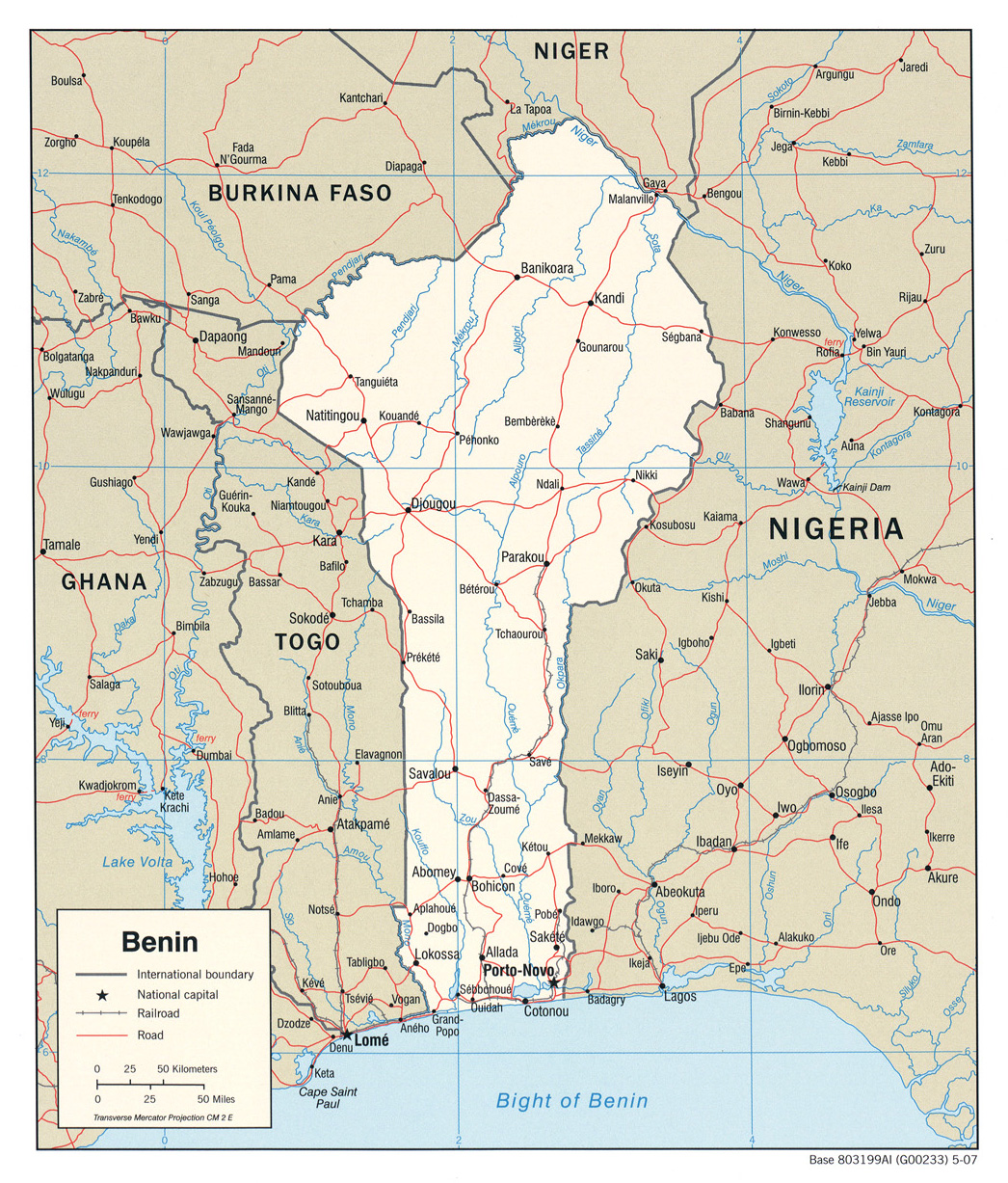
Niger has no railroad lines from their uranium mines to the sea, so it would have had to have moved the ore via trucks. Driving from the border of Niger through Nigeria to the city of Lagos or through Benin to Porto-Novo is about 400 miles. Let's say each truck could carry two tons of ore each. That means they'd have to assemble a convoy of 200 trucks. They'd have to add in vehicles to act as advance scouts and a dozen or so light, armed vehicles to provide security. Presuming good roads, the convoy could make the journey in a day, moving the uranium onto a ship would probably take longer, depending on how ships there are loaded.

Chances are zilch that this could have been done secretly. Nigeria or Benin would have had an opinion on the matter and would have demanded to know exactly what the convoy was carrying. Every intel agency in the area would be aware of such a large convoy and every naval power in the world would be aware of the movement of the ore onto a ship, which would have been tracked all the way to its destination. It's simply not credible to say that such a movement could have been made in such a way that the US would not have been aware of it.

Can President Bush credibly claim that due diligence was performed? Did Peggy Noonan judge Bush's honesty correctly? I think we can safely say that Noonan's character-judging abilities are completely worthless.

2008/12/16

Revisionism watch

A WaPo piece describes how President Bush has recently begun to display his "sensitive side." Funny though, the "burrowing" of Bush Administration people (transforming political appointees into career civil servants as appointees are expected to vacate their jobs when a new administration takes over, but it's difficult to fire a civil servant) proceeds full speed ahead.

Has Bush shown much compassion and sensitivity over the years he's been in office? Well, in late January 2003, a Methodist Bishop tried to get an audience with Bush to discuss the upcoming Iraq War, saying that it "violates God's law and the teachings of Jesus Christ." The Bishop was refused and their face-to-face conversation never took place. In August 2005, Cindy Sheehan wanted Bush to take time out from his vacation and talk with her about her son's death and what, if anything, he was doing to see to it that more sons and daughters and husbands and fathers didn't die needlessly in Iraq. She too, was refused an audience.

Also, a report from the Senate Armed Services Committee makes it quite clear that Bush is directly linked to detainee abuse by his having stated that "...the Geneva Convention did not apply to the U.S. war with al Qaeda and that Taliban detainees were not entitled to prisoner of war status or legal protections." The entirely predictable result was that:

Many of those deaths caused by abusive treatment have been formally characterized as "homicides" by autopsies performed in Iraq and Afghanistan (see these chilling compilations of autopsy findings on detainees in U.S. custody, obtained by the ACLU, which reads like a classic and compelling exhibit in a war crimes trial).

For Bush to suddenly start claiming to have been a "compassionate conservative" (a term that many liberals dismiss as being a contradiction in terms) is like Calvin of the comic strip Calvin & Hobbes suddenly deciding on December 24th that he'd better start being a good boy or Santa won't bring him any presents.

And hey! Bush is now claiming that he never said that the Taliban had been eliminated! Erm, uh, yeah, and the "Mission Accomplished" banner had been spontaneously put up by the sailors of the USS Abraham Lincoln and was not a project directed by Karl Rove's people.

And oh yeah! General Eric Shinseki didn't really contend at the time that Rumsfeld's plan for the occupation of Iraq was fatally flawed!

Sigh! Yeah, unfortunately, we're going to hear a lot more of this kind of revisionism over the next few months.

2008/12/12

A reason to write a nice letter

The blog County Fair within the website Media Matters has been busily documenting the wretched, sorry spectacle over the last few weeks of the traditional media panting, slavering, grasping and lusting to write the next "Whitewater" story or to kick off the next "Monica Lewinsky" scandal. America apparently has a bunch of middle-school-age adolescents in charge of much of the traditional media.

The good news is that we saw some pushback on MSNBC Live on 11 December.

...anchor Tamron Hall forcefully challenged Republican strategist and TheHill.com blogger Doug Heye's characterization of President-elect Barack Obama as a "good friend" of Illinois Gov. Rod Blagojevich's (D).

Now obviously, if Obama and Blagojevich were "good friends," it would be entirely appropriate for the strategist's/blogger's report to go unchallenged. It would be entirely appropriate for the MSNBC person to smile and say "Thank you for appearing with us" and to then go on to the next topic. But because Ms. Hall found Mr. Heye's description to be off the mark, she DID HER JOB as a newsperson and challenged him.

This is the kind of thing that active and alert citizens should notice and encourage. Any time that a traditional media outlet goes beyond merely ignoring a bad story and instead challenges the spreader of lies, we should let the station know that their action is noted and appreciated.

Write to:

MSNBC
Mr. Phil Griffin,
Senior Vice President, News
NBC Television Network
30 Rockefeller Plz
New York, NY 10112
phil.griffin@nbc.com

Steve Capus,
President, NBC News
steve.capus@nbc.com

MSNBC
letters@msnbc.com
MSNBC/Microsoft-NBC
30 Rockefeller Plz
3rd Fl
New York, NY 10112
(212) 664-4444

You can only send an email to Mr. Capus, but Mr. Griffin will take both emails and paper letters and MSNBC as a whole will take emails, paper letters and phone calls.

How should we as citizens deal with the notion, sincerely held by many people, that the best way to deal with a silly, trivial media obsessed with gossip and personalities, is to ignore them? As Republicans have ceaselessly pointed out since 9-11, we live in a dangerous world. As the writer, lawyer and activist Mike Hersh points out, President Clinton's anti-terrorist efforts ran into continual Republican roadblocks.

President Clinton also ordered a "terrorism threat assessment of every federal facility in the country," which had "already begun" when, in February 1995, the Clinton Administration introduced a counter-terrorism bill in the Senate (S. 390) and the House of Representatives (H.R. 896). Note: this was before the Alfred P. Murrah Federal Building Oklahoma City bombing on April 19 that year.

--------

Unfortunately, Republicans sabotaged Clinton's efforts to keep us safe. If in force before April 19, 1995 federal officials might have detected and prevented the Murrah Building plot.

Why didn't people notice and complain about this obstuctionism? Well, a silly, trivia-obsessed media is a dangerous distraction that allows i
mportant work to be put aside in favor of hysterical scandal-mongering and baseless impeachments. It's very much in our self-interest as American citizens to nip this ridiculous stuff in the bud and to stop it before it gets too far.

What is the extent of the current problem? Eric Boehlert points out that;

As much as I hate coming to the defense of "conservative pundits," they're hardly the only ones making the "tainted" claim, despite the fact Obama was "exonerated" on the tapes. It's pretty much the entire Beltway press corps that's been playing up that angle.

Crooks & Liars observes that "taint" seems to be the "Word of the Day." Two Democratic politicians, both from Illinois and one is supposedly "tainted" by the scandals of the other. But gee, it's funny that George W. Bush and Tom DeLay were two Republican politicians from Texas and somehow, for some strange, amazing, inexplicable reason, Bush was never "tainted" by the scandals of DeLay. Funny how that works!

2008/12/09

Whitewashing history

Paul Richter writes for the Los Angeles Times: "In a sweeping defense of his record, President Bush asserted Friday that his administration is leaving the Middle East a 'freer, more hopeful and more promising place' than when he took office.

When Bilbassy-Charters asked if he'd had any second thoughts, Bush replied: "I'm sure there will be. I mean, there's been some disappointments."
Q. "Like what?"
Bush: "Well, like, Abu Ghraib was a terrible disappointment. And admittedly, I wasn't there on the site, but I was the Commander-in-Chief of a military where these disgraceful acts took place that sent the absolute wrong image about America and our military.

If Bush is merely saying that Abu Ghraib was sending a message to the world that was inconvenient to the US, that "Dang, it's too bad word got out about this," then it's hard to disagree with his statement. If Bush is trying to claim that Abu Ghraib somehow didn't represent his administration, that this was a "rogue operation" of some sort, 'fraid not.

On March 11, 2008, House democrats (sic) failed to garner enough votes to override President Bush’s veto of a bill that would have made it illegal for the CIA to use brutal "interrogation" techniques to extract information from suspected terrorists. The vote was 225 to 188, missing the two-thirds majority needed by 51 votes.

Yes, the vote was a clear majority, good for those 225 Congresspeople, but 188 of them showed themselves to be as morally bankrupt as their President demonstrated himself to be. No, Abu Ghraib may not represent America as a whole, but it most certainly represents a substantial group of Americans.

Does Abu Ghraib represent the US military?

Sen. Carl Levin (D-MI) said he found the Pentagon report “very troubling” would hold hearings on how the SERE training methods “migrated” into Iraq and Guantanamo as the basis for interrogation. “They were put to a purpose that was never intended,” he said. [emphasis added]

Unfortunately again, the answer is that while Abu Ghraib does not represent the whole of the US military, substantial sections are so corrupted that again, the term "morally bankrupt" is appropriate.
----------
Q. "But some say, sir, that the removal of Saddam Hussein has bolstered Iran and make emergent as a regional superpower."
Bush: "I disagree completely with that. I think the emergence of a democratic and stable Iraq on Iran's border is in the -- will help more likely keep the peace vis-à-vis Iran in the Middle East. . . . "

Erm, Iran has been greatly strengthened by the US invasion of Iraq, says the Jerusalem Post.

And from the Asia Times:

In short, Bush had from the first facilitated the very event he warned would be a disastrous consequence of a US withdrawal from Iraq: the takeover of a large part of the country by an Iranian-backed militia. And while Bush contrasts the promise of democracy in Iraq with the tyranny in Iran, there is now substantially more personal freedom in Iran than in southern Iraq.

Not sure if calling Iran a "regional superpower" is entirely appropriate, but calling Iraq an emerging "democratic and stable" country is, well, it's a nice idea, says Americans, but "61 per cent of respondents think Iraq will probably never become a stable democracy."

Bush's attempt to whitewash history is running headlong into the reality of the situation.

2008/12/06

Juan Cole argues with President Bush

President Bush gave a speech on US-Mideast policy at the Sabas Forum on 5 December, Juan Cole then argued with much of what he said in that speech. In doing so, Cole reviewed and again called attention to many aspects of Bush's policies and explanations for those policies that have irked and annoyed liberals, lefties and progressives over the years.

Primarily, Bush annoys progressives by giving his listeners an entirely one-sided and very highly selective view on causes and events. He doesn't just speak as if wearing blinders, he speaks as if he were observing these things through a straw. As Cole observes, when speaking of various Middle Eastern "bad guys,"

A popular Shiite anti-Shah, anti-imperialist movement is no different from a small hyper-Sunni terrorist group?

According to Cole, Bush seeks to present the entire Islamic world as an:

undifferentiated terrain of seething irrational hostility

And I'm sorry, but Bush just plain flat-out lies in this paragraph:

"When Saddam’s regime fell, we refused to take the easy option and install a friendly strongman in his place."

Cole reviews the well-documented history of the Bush Administration's clear intention of installing Ahmed Chalabi as the Iraqi "friendly strongman" and continues with how the US tried again with Ayad Allawi. Both attempts failed because of Iraqi opposition. Neither attempt was unsuccessful because the US decided that such a thing would violate American ideals of democracy.

Even if we were to assume that Bush was being entirely honest and sincere in his desire to see democracy spread across major portions of the world, we'd still have a major problem with the way that Bush has chosen to go about it. The methods one chooses are important. Back during my college days, one of my professors got very excitable about the errors that people were making in interpreting a subject. Someone pointed out later that the professor had to realize that "He's not cutting down a forest, he's irrigating a desert." By the same logic, Bush and the neoconservatives around him seem to think that creating conditions for a democracy simply means getting rid of the local dictators. In reality, getting a democracy up and running means:

You need institutions like a well-trained legal and judicial establishment that can lay the groundwork for a rule of law. You need vital, independent unions and chambers of commerce. You need security. You need lots of things besides the Marines.

According to Cole, Saddam Hussein's Baath Party is the "bad guy" of today, but Bush's speech erases the history of how the Baath Party got into power back in the 1950s and 1960s with the enthusiastic backing of the US. Yes, it's entirely possible that "The Establishment" of the US regrets doing that and is now determined to right those old wrongs, but when their spokesperson ignores the history of US complicity in Mideast violence, there's no reason for anyone to have confidence that any new policies are being planned.

It's of course impossible to blame just Bush and his people for all this. Democrats haven't really tried to present an alternative view. I think that situation has changed a bit from years ago and the Democratic Party is more ideologically progressive than it was when Bush took office. The incoming presidency of Barack Obama is, I believe, a big improvement over Bush's presidency, but it's nowhere near enough for a lot of impatient critics, among whom I count lots of my buddies in the anti-war movement. The traditional media hasn't been presenting alternative views either, but again, the rise of the netroots with a more leftist perspective has ameliorated that problem somewhat. We're still not "there" and the press corps appears to still be unhealthily obsessed with Hillary Clinton and trivia in general, but I think we're making progress.

2008/11/30

WaPo editorial misinforms

Re: "Road Map in Iraq" Nov 30

This piece appears to be designed to appeal to what political writers call the "low-information voter." First of all, it is true that President-Elect Obama has not "acknowledged its [the "Surges"] success in greatly reducing violence around Iraq." Yes, the "Surge," a temporary increase in the number of US troops in Iraq, was an element in the quieting of Iraq over the last two years, but as several Democratic Presidential candidates pointed out at the time, the increase in troops was only one of the many factors that produced that success. The stand-down of Muqtada al-Sadr and the anti-al Qaeda-in-Iraq "Anbar Awakening" were also very crucial elements without which the "Surge" would have gotten nowhere.

Yes, the "new democratic system" has indeed gained a footing in Iraq, but the editorial goes to great lengths to avoid pointing out that the happy situation owes far less to American leadership than it does to tough bargaining by Iraqi Prime Minister Nouri al-Maliki. The statement "The Bush administration worked patiently and tirelessly to negotiate the new agreement" is flat-out false. President Bush's original idea was to make a "conditions-based" as opposed to a "calendar-based" withdrawal, in other words, for American troops to remain in Iraq essentially forever. Bush gave way under pressure from Iraq's Prime Minister.

It's not at all clear that Iraq stood up to pressure from Iran. It's hard to believe that Iran opposed an American timetable for withdrawal.

Has President Bush won a victory in Iraq or an equivalent thereof? I would argue that no he hasn't, as by my understanding, victory in Bush's eyes meant a permanent American presence and an American monopoly on oil drilling in Iraq. This definition of victory is not just that of the American left wing, but of much of the world, including the great majority of Iraqis. The idea that America invaded Iraq simply to leave behind a better, more democratic system is certainly consistent with Bush's rhetoric, but not at all consistent with his actions.

Can we blame Bush's failure to secure a permanent American presence in Iraq on mere "mismanagement"? That strikes me as even more simplistic and reality-avoiding than the idea that Bush aimed merely for a stable and democratic Iraq. The main problem with pursuing a counter-insurgency strategy as opposed to Defense Secretary Donald Rumsfeld's idea of an American "light footprint" was always that a counter-insurgency strategy meant getting a serious number of "boots on the ground" in Iraq.

The only way to have done that was to have had a draft. Yes, Bush has never let the word "draft" escape his lips and has never explicitly advocated that Americans sign up for the Army in large numbers, but neither has anybody else on the Republican/conservative side of the political aisle. The entire subject has simply been a "don't go there" for the American right wing as a whole.
This editorial reminds me of how my brother-in-law described Secretary of State Colin Powell's dramatic UN presentation of February 2003: "Impressive, if you didn't know anything about the subject before watching him. If you were reasonably informed beforehand, not impressive at all."

2008/11/24

Bizarre anti-Obama arguments

I had my letter published in my local newspaper and went to the letters page online to see if there had been any comments concerning it. Nope, but I was struck that there was a commenter who was obviously a conservative and/or a Republican who was very unhappy about Obama's failure to deliver "change."

Posted by bpphilly 11:03 AM, 11/24/2008
Tango: Rahm Emanuel, Eric Holder, Tom Daschle, Gregory Craig and soon enough Hillary Clinton. Early on this admin reaks of the Clinton White House, and seems to offer no real "change" other than nameplates on the offices. So what again where you saying? Read a real news outlet? How's this:> Get a clue. But typical of most libs you're too busy attacking and hating the right to even notice how wrong you are.

After a liberal questioned what bpphilly meant by this he responded:

Tango: you really are a dipsh*t...Obama promised Hope and CHANGE. His admin is now full of Washington insiders...exactly what you cite is wrong with Bush's White House.

Except that nobody ever complained that Bush's government was "full of Washington insiders," we complained that Bush and his people were criminals, not that they were merely "insiders." So I responded:

Oh good grief! "Change" means Obama shouldn't have anyone in his cabinet who has any Washington DC experience? Aw dude...lemme explain something to you, I'll type slowly so you can get it, "change" means "different from the Bush Administration"!!!! OK? As long as Obama's people have a "D" after their name and not an "R," they're "change."

to which bpphilly gave a disgusted reply:

You're right...typical "do as I say, not as I do" Dems. Whodda thunk?

But Obama never ran an "anti-insider" campaign! He ran an "anti-George W. Bush" campaign. The most effective attack line of the campaign was that John McCain was planning to run "a third Bush term" The line, an entirely accurate one in my humble opinion, came from a February campaign event where a reporter asked McCain whether he “would be in effect carrying out a third Bush term.” McCain replied with warm compliments towards the President, which indicated that he'd do just that. The North Carolina Democratic Party offered the following in October:

John McCain offers nothing more than a third Bush term. On Iraq, he says that he wants to stay in Iraq for the next 100 years. On tax cuts for the wealthiest Americans, he has flip-flopped and now sides with President Bush. He's the candidate of Washington lobbyists and represents the status quo.
When it comes to the economy, health care, and creating a responsible, effective exit strategy for Iraq, McCain proposes no new ideas. 

Note that these are all highly specific references to G.W. Bush/Republican Party policies. In no sense is this a general attack on "Washington" or "Babylon on the Potomac" or "pointy-headed bureaucrats" or any other Republican term of disapproval. It's impossible to read these Democratic Party attacks as meaning that former Clinton Administration people would not be welcome in an Obama Administration.

Our press corps is, of course, never satisfied. Back in 1993, the then-Political Director Rahm Emanuel and the now-Chief of Staff Rahm Emanuel was and is considered unsatisfactory. First because in 1993 he was "inexperienced" and now in 2008 because he's a "Washington insider." There's simply no possible way to ever satisfy some people.

In a recent National Review column, the editor there says:

And that's change you can believe in from the Democrats? Establishing the Obama administration as the voice [of the] pro-abortion [rights] Left?

Well, first of all, Obama has always been pro-abortion rights (or pro-choice) and second, yes. For a Democratic administration to favor choice IS a change from the current administration. No one ever said Obama would be different from other Democrats. Obama never claimed that he'd strike out on a course that would distinguish him not only from the current Republican administration, but from all Democrats as well.

Strangely, many people who consider themselves to be liberals have a similar complaint, that pragmatism should outweigh ideology. This is a rather strange complaint as no one can determine a person's competence unless one has some idea as to what they're trying to accomplish. Corpwatch does a report called "Casualties of Katrina" that examines the struggle that the citizens of New Orleans have had in reconstructing their lives after the disastrous 2005 hurricane. Corpwatch presents no evidence that their struggles have been made more difficult deliberately, but it does present a picture of a highly uneven recovery that's not easily explained. For instance: "...there has been a boom in the casinos of Biloxi, Mississippi, yet the local shrimping community has failed to recover."

Let's presume that these problems are due to simple factors like incompetence. We can then say that the people in charge of the reconstruction are unsuited for their jobs. But if the inconsistent nature of the recovery is deliberate, then the people in charge are splendidly competent and are doing precisely what they're supposed to be doing. It's simply impossible to determine someone's "competence" in a vacuum of purposes and intentions.

To complain that Obama's appointees are "ideological" is a rather bizarre complaint. Of course they're ideological. The thing that makes them new and good and praiseworthy is that they're ideological Democrats and not ideological Republicans.

2008/11/19

Review of NR piece on Missile Defense

The Weekly Standard did a piece urging President-Elect Obama not to cancel the Missile Defense project, a project that has cost the US, since the Bush Administration took office, about $60 billion.

Question: How well does the program work at shooting down missiles? "...missile defense assets have scored successes on 35 of 43 hit-to-kill intercepts, or 81.39 percent of the time." Sounds impressive, no? Well, no actually. Back during 2002, the Center for Defense Information recommended a series of steps to ensure that Missile Defense was being constructed to specifications so that it would operate in an effective manner.

In 2004, the Missile Defense Agency clamped down on any ability by scientists to ensure that the MDA designs worked as they were supposed to work. Keep in mind that the Bush Administration is working on an approach that's considerably more complicated than what it inherited from the Clinton Administration.

Is it possible that the MDA pursued its work effectively despite the lack of outside scientific oversight? Not if the Iraq War is anything to go by. It was reported in 2006 that in Iraq, not just millions, but billions of dollars were "burned" through "waste, fraud and war profiteering."

Unfortunately, the extremely high likelihood is that the MDA's impressively high hit-to-kill ratio given above is a complete fraud.

The Weekly Standard piece devotes a considerable number of paragraphs to how much consensus there is over Missile Defense, over how many nations agree to deploy it. The "elephant in the room" in this case is the enormous amount of money that's available to the defense contractors of any nation that gets cut in on the action. If these private businesses are able to get in on a scheme that awards them an enormous amount of money without any effective oversight from the US, that's a pretty good motivation for them to push their government to cooperate. It was pointed out in December 2002 that: "There has, in fact, been little to no assurance that this initial missile defense will be effective," but that "...opposition in Congress remains weak." The reason given is that "large special interest contractors" were driving the process.

Also, the NR piece brings up very scary specters of rogue third-world nations developing nuclear weapons. Former US Secretary of Defense William Perry says:

Given that we are concerned about the missile threat, we must also examine other ways of dealing with it. Throughout the Cold War we faced a much greater nuclear missile threat without a national missile defense. During that period our national security depended upon the effectiveness of our deterrence forces, which are still overwhelmingly powerful. We need to examine the extent to which we are willing to continue to make our national security dependent on deterrence. Is deterrence somehow ineffective against the Third World nations looming as future threats? If so, why, and what can be done to make it more effective?

Proponents of Missile Defense declared back in 1983 that Mutual Assured Destruction (MAD), the foundational building block for the doctrine of deterrence, was dead. I wasn't convinced of that back in 1983 and I'm not convinced now. Deterrence was built upon the fact, not that the Russians Communists were either Russians or Communists, but that they were human. With the exception of modern-day suicide bombers operating in Iraq and Japanese Kamikaze pilots back in the Pacific during World War II and a few others, people (aw heck, let's just say organisms) generally seek to survive. A nation fires a missile, that missile tends to be pretty easy to track back to where it came from. A single person or small group such as the 9-11 hijackers may be willing to commit suicide, but that tells us very little about how whole nations behave.

Is diplomacy dead? Have the past eight years proven that one cannot make bearable deals with "evildoers"? I actually think the past eight years have proven that President George W. Bush is incompetent at diplomacy, not that diplomacy itself is somehow lacking in effectiveness. Case in point is peace between Palestine and Israel. Bush said back in January 2008 that "...both sides are getting down to the business of negotiating." In early November 2008, Secretary of State Condoleezza Rice was assuring the world that "Israeli-Palestinian Peace Process Has Not Failed," even though "The talks have made little tangible progress."

I was convinced back in the 1980s that Missile Defense was a classic boondoggle, designed far more to take money away from taxpayers and to award it to private contractors, than it was to anything else. The NR piece gives me no reason to change that opinion.

2008/11/17

WaPo frets over allegations of liberal bias

The problem with Deborah Howell's latest attempt to reassure conservatives concerning that ol' boogeyman "Liberal Bias" is that she doesn't appear to understand what journalism is all about. Is the problem she identifies, that conservatives are under-represented in the newsroom, a general across-the-board problem in the news media? Hardly. The Sunday talk shows for November 16th, shortly after a Democratic landslide sweep of the Presidency, the House & the Senate were devoted to..."how does the GOP recover; how does it map out a new future?"

Uh, pardon me, but who gives a rat's $#@?!?!? Why are the troubles of the Republican Party even remotely interesting to a national audience that just rejected the GOP wholesale? Why can't the Sunday talk shows cover, y'know, the upcoming Obama Administration, their personnel choices, their policy preferences, etc.?

Looking at Howell's report on the alleged "bias" shown by the WaPo, she cites a front-page piece on

"Troopergate" -- the allegation that Alaska Gov. Sarah Palin fired her state's public safety commissioner because he wouldn't dismiss her ex- brother-in-law from his state trooper's job.

But unlike Whitewater, a story that the traditional media covered obsessively throughout most of the Clinton Presidency, "Troopergate" is actually a legitimate story concerning Governor Palin's abuse of power, a story that was extremely relevant considering that she was applying for a job that would have placed her a 72-year-old's heartbeat away from the US Presidency. It's difficult to understand why anyone would object to this story as an example of mere "bias" without looking at the story itself, how accurate the story was and how relevant it was to the national conversation as a whole. Howell's column makes no attempt to evaluate any of this. Howell simply cites the story as an example of the paper's "Liberal Bias."

The question is, should the WaPo be applying some sort of quota system, so many conservative writers to so many liberal writers or should they simply try to report the facts and try to report on important, relevant stories as they come up? The subsite "County Fair" at Media Matters says:

To [Howell's column], our response is simple: Who's stopping conservatives from being hired in newsrooms? Honestly. If Newsbusters can document how scores of qualified College Republican grads were passed over by local newspapers to poorly paying jobs to cover local zoning commission jobs simply because the applicants were conservative, we'd love to hear about it.

The "problem" in getting conservatives to apply for newsroom jobs is identical to the "problem" in getting them to apply for college professorships. Both of these are poorly-paid jobs that take a lot of work. Yes, ideological motivations are important to both jobs. If one has a liberal worldview, that view will come out in the lectures that one gives or in the articles that one writes. Of course, as America's media as a whole is largely controlled by just six companies, it's not clear why the owners of these six companies can't exert effective ideological control by simply making a few phone calls to their people in the field.

I would suggest that the focus of the Sunday talk shows on the future of the Republican Party is the problem and that the focus of the Washington Post on writing liberal articles is a sign of health. The talk shows appear to be concerned with what the owners of the six media-owning companies want, whereas the WaPo writers are concerned with what actually matters to their readership.

2008/11/14

Moral responsbility for innocent Guantanamo prisoners

Dick Morris and Alan Colmes on Guantanamo and what to do with innocet prisoners there:

ALAN COLMES: ...you know, the whole idea that what this president has done -- enemy combatants, that he can declare anybody an enemy combatant -- people not having rights to an attorney --
MORRIS: Let's --
COLMES: -- locking people away without an opportunity for redress.
MORRIS: Well, let me --
COLMES: That's radical.
MORRIS: ...Enemy combatants. As we point out in Fleeced, there have been 225 people released from Guantánamo, and 50 of them -- 50 of them -- have taken the battlefield and fought against American soldiers. And we know, because we've killed them or wounded them, and we have their proof -- the DNA -- that we had them under lock and key.
And now Obama's going to close Gitmo, and all of those people are gonna be back in the field, fighting against us.

First off, I very highly doubt that 50 former prisoners have gone back to the battlefield to fight against Americans and please note that closing Gitmo does not automatically equal letting prisoners go. Prisoners who can be proven guilty will obviously be kept in custody, but let's say Morris is right. What to do about people who are unjustly incarcerated? 1) The US can keep them indefinitely, but that's morally indefensible. 2) The US can execute them, but that's even more grotesquely immoral. 3) The US can remove their motivation to go back to the battlefield and fight Americans.

Carrying out option number 3 would mean punishing those who are responsible for allowing the moral abomination of Guantanamo to exist in the first place. By excusing and sweeping Guantanamo and other, assorted atrocities under the rug, the US demonstrates that the lives of Muslims and our own moral culpability are of no concern to us. By punishing the perpetrators, the US demonstrates that Guantanamo really does represent an abhorrent and condemned chapter in our history.

The relevant campaign statement from our President-Elect is:

If you were a Muslim overseas listening to Rudy Giuliani say "they are coming here to try to kill you," which is the tenor of many of the speeches that are delivered by Republicans, you would get an impression that they are not interested in talking and resolving issues peacefully. Now, what we need to do [to reach Muslims] is we need to close Guantanamo. We need to restore habeas corpus. We need to send a strong signal that we are going to talk directly to not just our friends but also to our enemies.

Source: 2007 Des Moines Register Democratic debate Dec 13, 2007 
 

Note that President-Elect Obama suggests going well beyond mere statements. He suggests taking concrete actions to assure Muslims that yes, Americans really do regret ever opening up Guantanamo.

Camille Paglia and the new face of the Republican Party

Camille Paglia produces an amazingly incoherent essay, with "facts" she appears to have pulled straight out of her butt:

But John McCain ...was... a candidate of personal honor ...

Uh, really? I thought his campaign was the absolute pits and about as "honorable" as a road race from the 1979 movie "Mad Max."

In the closing weeks of the election, however, I became increasingly disturbed by the mainstream media's avoidance of forthright dealing with several controversies that had been dogging Obama -- even as every flimsy rumor about Sarah Palin was being trumpeted as if it were engraved in stone on Mount Sinai. For example, I had thought for many months that the flap over Obama's birth certificate was a tempest in a teapot. But simple questions about the certificate were never resolved to my satisfaction. Thanks to their own blathering, fanatical overkill, of course, the right-wing challenges to the birth certificate never gained traction.

Obama's birth certificate was produced and a scan of it was featured on Daily Kos. There simply are no serious outstanding questions to be asked about it. Every possible objection has been voiced and answered. That's why "right-wing challenges...never gained traction." Paglia then extends her charge to cover the Ayers controversy.

As Media Matters points out:

The lack of media attention to the [G. Gordon] Liddy-McCain relationship is one of the clearest double standards in recent political history. McCain and the news media have devoted an extraordinary amount of attention to Barack Obama's ties to Bill Ayers, yet until last night, McCain hadn't been asked a single question* about his ties to Liddy, a convicted felon who has instructed his listeners on how best to shoot law-enforcement agents. [emphasis added]

How Paglia can claim that the traditional media "avoided" the Ayers question is a mystery to me.

How dare [Alaska Governor Sarah] Palin not embrace abortion as the ultimate civilized ideal of modern culture?

Who in the heck does?!?!? Abortion is an unfortunate necessity because unintended events happen and because abortion/carrying the child to term and giving birth to it is a yes/no, up/down choice. As the decision has to be made promptly, one specific person has to have the clear, unequivocal authority to make the final decision. There are those who would give that decision to someone other than the mother-to-be. Pro-choicers don't agree with those people. It's not a matter of a wonderful versus a horrible decision, it's a matter of who gets to make the call.

How tacky that she speaks in a vivacious regional accent indistinguishable from that of Western Canada!

Who in the heck ever complained about that? This sounds like those complaints that "liberals didn't like (the younger) George Bush because he spoke with a Texas accent." Excuse me, but Molly Ivins came from the same region and we loved her. Jim Hightower is also from Texas and he's reasonably popular as well. In no case did I ever see any examples of any liberals uttering any sort of quote that even vaguely attacked Bush for being from Texas. I'm not saying that no liberals have ever attacked either Bush or Palin for their regional accents, but I'd need to see some attributed quotes before I'm prepared to take anyone's word for it that any such prejudice has ever existed.

Liberal Democrats are going to wake up from their sadomasochistic, anti-Palin orgy with a very big hangover.

Again, this just causes me to go "Whu-u-u-uh?!?!?" Remember that Republicans have been equally rough on Palin, partly because her failure to answer simple questions embarrasses them and because they're (quite rightly) terrified that she'll be seen as representing the Republican Party.

Paglia claims that Palin is a naturally smart person. Sure, I'll agree with that, but the problem is not that she isn't smart. What she revealed in September was not that she wasn't smart enough to understand what the "Bush Doctrine" was, but that she just never cared enough about foreign policy issues to keep current on the disputes that were then taking place. Anyone even minimally paying attention (It was pointed out that both her running mate McCain and his opposite number Obama were able to answer the "Bush Doctrine" question immediately & correctly) should have been able to name a doctrine that's a foundation of Bush's foreign policy. By claiming that John Edwards was equally unprepared to be a Vice-Presidential running mate, Paglia shows that she's completely ignoring the question of how much Palin actually knows and cares about policy details.

Is Palin a "popular phenomenon"? Well, with the hard-core right wing she is, and that's why we on the left love the idea that Palin represents and is seen as the face of the Republican Party! Believe me, our support for her is entirely malicious.

2008/11/09

WaPo Ombudsman & campaign coverage

Deborah Howell, the Ombudsman for the Washington Post, feels really, really awful about the paper's election coverage. Why does she feel awful about it? She feels that the WaPo tilted its coverage to favor Barack Obama and to make John McCain look bad. She backs up her assertion essentially by bean-counting:

The op-ed page ran far more laudatory opinion pieces on Obama, 32, than on Sen. John McCain, 13. There were far more negative pieces (58) about McCain than there were about Obama (32), and Obama got the editorial board's endorsement. The Post has several conservative columnists, but not all were gung-ho about McCain.

Problem: Obama and McCain did not run similar campaigns! Comparing the two campaigns is an apples & oranges exercise. The demagoguery of McCain's Vice-Presidential running mate, Alaskan Governor Sarah Palin, was so extreme that the death threats made to Obama reached levels to where the Secret Service had to make the Obamas aware of them.

The Secret Service warned the Obama family in mid October that they had seen a dramatic increase in the number of threats against the Democratic candidate, coinciding with Mrs Palin's attacks.

Is it really fair or appropriate to do a bean-count to see how "biased" or "tilted" the WaPo's election coverage was without taking into account that the rhetoric coming from just one side was so demagogic, that it sounded so much like it was coming from a lynch mob, that the Secret Service was alarmed at the number of death threats that Palin's rhetoric was provoking?

And I'm sorry, but I really have to stick up for Palin here:

Irate John McCain aides, who blame Mrs Palin for losing the election, claim Mrs Palin took it upon herself to question Mr Obama's patriotism, before the line of attack had been cleared by Mr McCain.

Sorry, wrong answer!!! A presidential candidate is responsible for his campaign. Period! No ifs, ands or buts about it! That's why candidates say "I'm [so-and-so] and I approve this message" at the end of all of their campaign commercials. Palin has zero responsibility for her words, whether she decided to say them on her own or not. The campaign gives her the script that she speaks from, either on paper or via a teleprompter. Her job is to read the words given to her. She refuses to do the job, she gets fired (The campaign may be hopelessly incompetent, but they're still legally responsible). Absolutely no one is ever, under any circumstances, going to allow a partner in his or her campaign to just run off by herself and do her own thing. Ain't gonna happen.

McCain himself had to "dial it back" when a woman told him at a "Town Hall Meeting" that she was worried because she was convinced that Obama was an Arab. McCain snatched the microphone away from her and said that Obama was "a decent man" (And no, saying that Obama's "a decent man" doesn't really constitute an objection to the claim that he's an Arab). The inflammatory accusations were pulled back a bit.

Another problem with Howell's evaluation as to how well the WaPo did is how the paper did on "horse-race" stories versus "issues" stories:

The count was lopsided, with 1,295 horse-race stories and 594 issues stories.
----
There were no broad stories on energy or science policy, and there were few on religion issues.

My feeling on "horse-race" stories is that well, any idiot can read a poll and there are at least half-a-dozen polling firms out there that do reasonably reliable work. Interpreting a poll to see what will happen next? That's far more a matter of art than science. Anyone who tells fortunes using palm reading, tarot cards or tea leaves is perfectly capable of (and probably has just as good a record at) making reasonably reliable guesses based on polling data.

What would I prefer the WaPo spend its time & resources on? That's easy. According to Bill Hamilton, assistant managing editor for politics, the paper is in the business of providing what they "were uniquely able to provide our audiences both in Washington and on the Web." Now, let's see, what can a large, well-funded, well-connected institution provide that, say, a blogger can't? Or what can it provide more easily than a lone blogger can? How about "broad stories on energy or science policy, [or] ... religion issues"?

In other words, the WaPo would serve the public interest much better by chucking at least three-quarters of the "horse-race" stories and concentrating more on "broad stories" on issues. I'm interested in seeing the WaPo concentrate on doing what it's good at. Let the bloggers and small papers do the "horse-race" stuff. The WaPo should concentrate on "issues" stories where they take a serious look at the issue, at each candidate's plan for dealing with the issue and for how well their plan is likely to work. Based on looking at a few Palin talks, I'd guess the McCain campaign wouldn't come off looking very good.

2008/11/05

Election reactions

Ah, the sweet smell of success! Victory has been attained, but it's not a military-type victory, attained with the blood of our enemies, the wailing of foreign widows and the crying of the children of other lands. No, the election of Barack Obama by 63 million to 56 million was obtained peacefully, with persuasion, with good arguments, and yes, with an economic situation that was the direct result of Republican rule over this land since 1981 (CEPR counts Clinton as a "Republican-lite" for the purposes of this study). Certainly, the Mideast, with the exception of Israel & the Kurdish NorthEastern part of Iraq, has been hungry for change and so welcomes the American regime-shuffling.

And yes, I know it's mean, but I really had to guffaw at the National Review Online guy who bitterly complained that:

Just watched Wonder Boy's speech. Hmph. "Callused hands?" When did he ever have callused hands?

Ri-i-i-ight! Like, anybody at the NRO knows about "callused hands" from anything but storybooks and the occasional field servant that they dealt with in their youth. He then blames "the swooning complicity of the media," but it's quite clear that the traditional media was firmly on the side of McCain throughout the election campaign.

Media Matters also compared coverage of Obama's association with former Weather Underground member Bill Ayers to coverage of McCain's association with G. Gordon Liddy, whom Chicago Tribune columnist Steve Chapman has described as McCain's "own Bill Ayers."
----
Moreover, while these same media outlets mentioned Obama's ties to Ayers 311 times in 2008 through Election Day, they produced only five reports mentioning McCain's connections to Liddy, whom McCain has praised and repeatedly associated with in public and in campaign settings.

And our NRO guy then has asks a question:

Sour? You bet I'm sour. Where was conservatism in this election?

Hmm, okay. but we have to ask, what exactly does he mean by "conservatism"?

Where was restraint in government? Where was national sovereignty? Where was liberty? Where was self-support?

I heartily agree that government has been completely unrestrained under Bush. What with warrantless wiretapping, detaining prisoners without evidence of wrongdoing in defiance of habeas corpus (or the Geneva Conventions, as applicable), voter suppression through the widespread use of "vote caging," (that is, "sending 'Do Not Forward' letters to minority voters that, if returned, could be used to challenge them as nonresidents"), vote purging (famously seen in Florida before the 2000 election) and the firing of US Attorneys who weren't sufficiently pursuing bogus "voter fraud" allegations (as opposed to "vote fraud," which is when vote suppression is done by the government).

Problem: Where was the NRO during all of this lack of "restraint in government"? Seems to me that conservatives of all stripes and varieties spent the early part of this century praising Dear Leader Bush and bashing the liberals who tried to object. Or did the bulldozing of Dixie Chicks' CDs strike people as an action where the right wing showed respect for political dissent? And remember:

The "K Street Project"—the most successful shakedown operation since the first Gilded Age—was the brainchild of Representative Tom DeLay and Grover Norquist...

I don't remember any conservative objections to that, either. Granted, the "K Street Project" was shut down shortly before the Democrats took over Congress, but let's not confuse a preemptive, defensive reaction to an action based on principle.

Quite frankly, Obama's choice of Rahm Emmanuel for Chief of Staff fills me with joy, as no, he's not as liberal as I'd prefer (He backed NAFTA and wants to privatize the border), but he "doesn't do 'bipartisan'," which I find completely cool at this point.

A piece on PhillyIMC makes an interesting charge, that as the left of 1993 didn't put up much of a fight to control Bill Clinton's "Third Way," "Republican-lite" tendencies, that the left of 2009 will be equally useless at guiding and directing an Obama Administration. I dunno. Seems to me that the left of today is much more together, more energetic, more connected than it was in 1993. President Reagan garnered genuine support from the American people and the elder Bush, who inherited a lot of that good feeling, was less of an overt criminal than the younger Bush is. When the press corps of 1993 launched its all-out assault on Clinton with idiotic crap like "Whitewater," the press being crazy and out of control was a new thing and progressives weren't sure how to handle such a thing. Nowadays, we're fully aware of it and know how to deal with it. That's not to say the netroots are as powerful as the traditional media is, but I think they're far more able to take on the combination of the right-wing noise machine and the traditional press then they were before.

Finally, I agree that there's a danger that Obama will become the new Dear Leader who can do no wrong and who will be defended from our side of the aisle whether he deserves it or not, but I think this blogger makes some very good points:

But I genuinely expect that those who have made the restoration of our Constitutional framework and preservation of core liberties a top priority over the last eight years will continue to pursue those goals with equal vigor, regardless of the change of party control. And few things are more important in that effort than having a Supreme Court majority that at least minimally safeguards those principles. It's hard to overstate the importance of last night's election outcome in ensuring a reasonably favorable Court majority and, even more so, in averting what would have been a real disaster for our basic rights and system of government had John McCain been able to replace those three Justices with GOP-approved nominees. By itself, maintaining the Court more or less as is won't reverse any of the Constitutional erosions of the last eight years, but it is an absolute prerequisite to doing so.

I think all the work we put into making sure that McCain did not succeed Bush was well worth it.