The court scholar serving Hermann of Thuringia.

The court scholar serving Hermann of Thuringia.
The scholar
Showing posts with label culture. Show all posts

2024/05/01

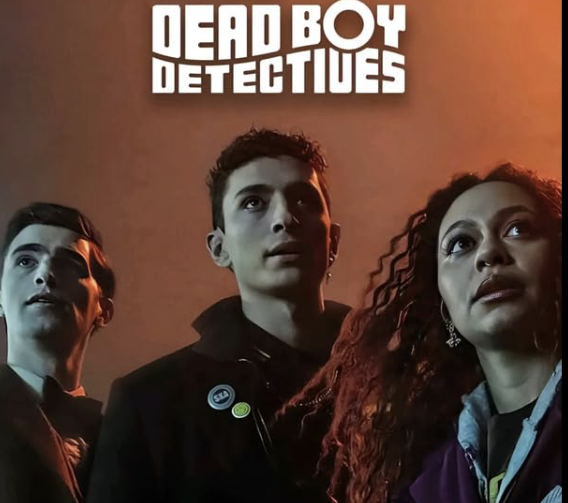
Dead Boy Detectives


Just finished watching the first episode of Dead Boy Detectives (Available on Netflix). Good stuff! Of course, I read the source material, so I'm familiar with the characters and their back stories. Pictured are the two dead boys. They're ghosts and the living young woman with them has psychic powers, so she can see them and talk with them. I like the philosophy/theology that forms the backdrop of their tales. 

Death, seen here with her brother Dream and someone who has just now died, acts kind of like the Viking Valkyries, she physically transports your soul to the afterlife. You get to chat with her for a minute or so and then she'll take you there. The whole point is, at least at the very end of your life, no matter how miserable or tragic your life was, you get to speak with someone who cares. 

In the comic book, there's a whole story about why Death has not taken the two dead boys off to the afterlife, but the first episode doesn't go into that. 

2021/12/27

“Let’s go, Brandon!”


President Biden was on the line at the NORAD Santa Tracker call and spoke with children who had called in to find out where Santa was. He and the First Lady were having short chats with them. One fellow was Jared Schmeck of Oregon, a fan of the former President Trump, who ended his time with the President by saying “Let’s Go, Brandon.”

Schmeck claims “’he didn’t intend his parting message to be vulgar.” But “The phrase ‘Let’s Go, Brandon’ has become a conservative dig at the Democratic president, a code for ‘F--- Joe Biden,’” so it’s hard to see how Schmeck could have been confused into thinking he was NOT delivering a vulgar insult to the President. Schmeck’s wife admitted online that her husband had indeed used a vulgarity against the President.

Schmeck called his remark a “joke,” and listed a series of policy disagreements with the President, but what he actually said was an insult and no one understands where the humor in his statement is. Schmeck also, of course, claims the election was “stolen” from The Former Guy.

Schmeck claims he was “utilizing my freedom of speech,” which is fine, but freedom cuts both ways. You’re free to use a vulgarity with anyone you choose, but others are free to disparage you for doing so.

I of course liked Joy-Ann Reid’s response tweet, but was very impressed with this one:

"Confession: I find it in poor taste to tell the President of the United States 'Let's go Brandon' when the man just wanted to wish you Merry Christmas. Good manners should still matter," conservative blogger and radio host Erick Erickson wrote in a series of tweets.

Fox News had a defensive-sounding headline for the angry liberal response, but appropriately stuck to reporting what liberals said.

Mehdi Hasan said:

“Encouraged by senior elected Republicans who pretend to otherwise care about ‘civility’ and who are never asked by the press to justify their indulgence of this childish and offensive slogan.”

Problem is, it’s one thing when you’re explicitly stating a political position like “Free the Hanoi 5!” or somesuch. Then people can recognize your earnestness and people can take your politics seriously. But when you use a vulgar slur, you’re just a vulgar jackass.

Update: Fox News does damage control.

Fox News called out their C-Team to run interference for the son of a Navy SEAL who thought it would be cute to insult the president so he could get a viral Instagram post. It was pathetic and so is Jared Schmeck.

Two examples that the Fox crew used. Yes, Robert DeNiro got up in front of an audience and said "Fuck Trump." He knew he was being transgressive and improper and his audience knew it too. No, Kathy Griffin did NOT meet with any approval for posting a picture of herself with Trump's "severed head." Her career as a stand-up comedian was dead for several years as a direct result.  

And again, I'm completely and utterly baffled by the assertion that Schmeck was attempting to make some sort of joke. There is simply nothing funny about his attempt. 


2021/11/13

Answer to a piece in the Philadelphia Inquirer.

This was published in the Inky on 12 November:

Dems lie if they say that critical race theory not taught in schools

Let's parse a paragraph of Thiessen's commentary of this last Friday ("Dems lie if they say that critical race theory not taught in schools"):

For the Marxists, the bourgeoisie were the oppressors. For the Nazis, the Jews were the oppressors. And today, in 21st century America, critical race theory teaches that Whites are the oppressors.

In Marx's day, the "bourgeoisie," the businessmen who ran the factories and sold commercial goods were in complete control of the state. The politicians all represented the businessmen. Is that true today? Not so much. Many other groups have gained quite a bit of political power.

In Germany before World War II, Jewish people were certainly prominent in the government and the culture at large, but by no means did they hold a commanding position. 

White people in opposition to Black people certainly had a regional advantage. In the South, they completely controlled the politics of the region. In the North, the political power of the abolitionists grew and grew until the Civil War broke out. Today, the descendants of the abolitionists hold a grip on the levers of political power, but yes, the racists have made great gains. 

The panic over Critical Race Theory is easy to understand. If you're not guilty of harboring racial animus, then you have no problem with CRT being taught.   



2021/06/30

What’s the status on Critical Race Theory?

Ed Prep Matters | AACTE Blog AACTE Members Stand Up for Critical Race Theory  - Ed Prep Matters | AACTE Blog 

Representative Marjorie Taylor Greene has a surefire method of detecting when Critical Race Theory (CRT) is being taught. She identifies a course given by the National Children's Museum as containing the 1619 Project, a set of essays that described the contributions to American history made by slaves and by the institution of slavery. So the definition of CRT is pretty elastic, the meaning is broad and vague.

Further definitions are given by the Texas Public Policy Foundation, with them identifying “the civil rights movement, the KKK, the Versailles Treaty, Nazis, NATO/the Cold War, 20th century Africa & Asia…“ as all indicating a suspect agenda. In other words, CRT is what separates a school course on American history from a children’s bed-time story.

A Republican Congressman decides he’s

...against a bill to remove Confederate statues from the Capitol because it's "animated by the Critical Race Theory concepts of structural racism, microaggressions, and a United States based solely on white supremacy."

This is apropos of:

Today, the House voted in favor of removing all treasonous confederate statues from our US Capitol. 120 GQP Republicans voted against removing them, thus cementing once again that they are indeed the party of white supremacy terrorism.

2020/08/24

Conversation on occupation of the South in the late 1860s

Reconstruction in Georgia | New Georgia Encyclopedia

Had a lengthy and interesting conversation on Facebook with someone who described himself as an amateur historian and appeared to be suggesting that Black people weren’t ready for emancipation in 1865.


He was initially upset by my posting a piece saying that Black Lives Matter people drove off a group of white supremacists, or in his telling, patriotic Georgians who were defending their heritage.


We discussed whether the Civil War was really all about slavery. I replied that yes, it was. As evidence, I supplied a link to the declarations of various Southern states in 1861 that made it very clear that, yes, slavery was the issue that was uppermost in their minds when the war commenced.


We got into a discussion about Black people in the South who died in the years immediately after they were freed from slavery.


Former slaves were left without any livelihood or means of support. They simply moved into the woods and lived a stone-age hunter-gatherer existence. According to a speech given by the Governor of Mississippi, it resulted in the death of one million blacks - dwarfing the combined deaths of Union and Confederate soldiers.

I first encountered this in one of Sierra Club founder John Muir's adventure books. He met such a family while on his thousand-mile walk from Indiana to Florida. His description is appalling.


He supplied a link to a piece that confirmed this after I searched around and found an author who confirmed that yes, perhaps a million Black people died during Reconstruction. He appeared to hint and suggest that Black people just weren’t ready for freedom by suggesting that it was the Emancipation Proclamation that killed them.


My own theory is taken from Carl von Clausewitz, who wrote On War. He lived from 1780 to 1831. The book was published after he died. He was a Prussian general in the Napoleonic wars. Basic idea of the book was that war is politics by another means. What this tells us is that the occupation that follows the fighting can be just as important to victory as the battlefield combat is.


Let’s start with the idea of “40 acres and a mule.” The single most profitable investment a Southerner could make was land and slaves. How much money were Southern landowners putting into land and slaves?


Since planters needed ever more funds to invest in land and labor, they drew on global capital markets; without access to the resources of New York and London, the expansion of slave agriculture in the American South would have been all but impossible.


So then, all of the sudden in 1865, all of the labor that plantation owners had purchased as an investment, walked off the job. Contracts are based on mutual advantage. Slaves weren’t getting any advantage, so there was no reason for them to stay on the job once the force that had been keeping them there was removed.


So the popular idea was to simply confiscate those plots of 40 acres from Southern landowners. That would most likely have required more force than Northerners were willing to deploy. When people who have lost a fortune are pressed further, they’ll strike back.


Now, if I were the George Marshall of the Lincoln Administration (See Marshall Plan of 1948) and was put in charge of planning the post-war reconstruction of the South, I’d give each freed slave money enough to purchase “40 acres and a mule.” That way, Southern landowners would get something out of the deal, even though they’d lose land and might switch to paying laborers as opposed to simply forcing them into working. If the former slave wanted to put money into industry instead, the US was starting up a really expansive phase of the Industrial Revolution, so there were plenty of opportunities there.


Why couldn’t the US do that? Lincoln was assassinated and Andrew Johnson, Lincoln’s vice-President, took over. Back in those days, the idea of getting a President and a Vice-President who were on the same page philosophically, the way Harry Truman agreed with Franklin Delano Roosevelt or that Lyndon Johnson agreed with John F. Kennedy, hadn’t really been developed yet. Andrew Johnson didn’t regard Black people as deserving of full civil rights.


Most importantly, Johnson's strong commitment to obstructing political and civil rights for blacks is principally responsible for the failure of Reconstruction to solve the race problem in the South and perhaps in America as well.


So, while the deaths of about a million Black people during Reconstruction is a really terrible thing, it’s not clear there was any obvious solution that the country was willing to accept.


2018/09/13

US Democratic vs Nazi platforms

Dinesh D'Souza made a film that Don Jr. saw and clearly, that was Don Jrs. only exposure to the material because he swallowed D'Souza's propaganda wholesale.

"Don Trump Jr. Calls Democratic Party 'The Real Nazis' After Watching D'Souza's Mess"

Okay, so let's look at what the Nazi Party platform of 1920 was:
  1. Unification of Greater Germany (Austria + Germany)
  2. Land + expansion
  3. Anti-Versailles - abrogation of the Treaty.
  4. Land and territory - lebensraum.
  5. Only a "member of the race" can be a citizen.
  6. Anti-semitism - No Jew can be a member of the race.
  7. Anti-foreigner - only citizens can live in Germany.
  8. No immigration - ref. to Jews fleeing pograms.
  9. Everyone must work.
  10. Abolition of unearned income - "no rent-slavery".
  11. Nationalisation of industry
  12. Divison of profits
  13. Extension of old age welfare.
  14. Land reform
  15. Death to all criminals
  16. German law, not Roman law (anti- French Rev.)
  17. Education to teach "the German Way"
  18. Education of gifted children
  19. Protection of mother and child by outlawing child labour.
  20. Encouraging gymnastics and swimming
  21. Formation a national army.
  22. Duty of the state to provide for its volk.
  23. Duty of individuals to the state 
Points 1 through 4, 16 and 21 are specific to Germany's concerns at the time.
Points 5 through 8, 15, 17 and 23 sound just like the Trump Administration today.
9 through 14, 18 to 20 and 22 okay, these sound like items Democrats could agree with. Not so sure about point 11, though. Some nationalization would be good, but lots of Democrats are strong believers in capitalism. 22 is also pretty much straight socialsm. Not really sure either 10 or 12 survived very long then or would survive under Democrats today. Michelle Obama would especially approve of 20.
It's a pretty mixed bag. Certainly Democrats would agree with some of the values expressed, but Don Jr. sounds as though he's citing a very one-sided version and doesn't have enough historical knowledge to really make careful distinctions.

2018/06/11

Superheroes and diversity


Just because I like to occasionally riff on stuff that’s not of earth-shattering importance.

Look at superheroes. We all got very excited about the recent Black Panther film, and the first black superheroes. The film took in more than $1.3-billion worldwide, proving once again that there is a huge black market.
Some people argued that it wasn’t a big deal. There were always black superheroes. What about Blade, Hancock, Cyborg and Iron Man’s sidekick? Black people should stop being greedy, I mean, there are at least five black superheroes. How many do you they want? Well, do you know how many there are in total? Marvel lists 7,000 official characters. DC Comics claims to have more.
So five out of a possible 14-15 thousand?! Yes, black people, you should be satisfied with that. Know your place.
Yeah, back in the late 40s, early 50s, we saw superheroes like Superman, Captain America, Batman, Sub-Mariner, Wonder Woman, etc. In the 60s, we got another wave. Spider-Man, Fantastic Four, Thor, Iron Man, Hulk.

There have been cool characters since, the new X-Men (Wolverine, Storm, Colossus, etc.), the re-booted Swamp Thing, his occasional foil John Constantine, The Endless (Dream, Death, Desire, etc.), the new Teen Titans (Cyborg, Raven, etc.). But yeah, as most of the possible powers and character types have been used up (The Legion of Superheroes has made some appearances in DC TV shows, but characters like Shadow Lass and Triplicate Girl are kind of ridiculous and hard to find useful employment for), it’s hard to assemble diverse teams today without deciding to, say, turn Nick Fury from a white character into a black one.

Spider-Man has done a good job with diversity. The initial character Peter Parker is getting a bit aged. Marvel ages its characters about a year for every seven years that pass in the real world. Franklin Richards, son of Reed and Sue of the Fantastic Four, was born in the mid-60s but is only in his tweens today. So even though Parker was a high-schooler back when he was invented, he’s long since graduated college and is running his own company.

So, time for a new Spider-Man, one who isn’t quite so old. Marvel decided to make the younger Spider-Man black. Hmm, how to get a female Spider-Man? Well, Gwen Stacey was Peter’s first love and she died tragically back in the 70s, so how about a Gwen from a different dimension who received spider-powers instead of Peter? Niches can be found, but it takes some imagining to fill them without just throwing all-new characters at people.
Ms. Marvel is filling another niche. Captain Marvel was a blond male. When he died, Ms. Marvel, a blond female, took over. The blond female has since taken up the Captain Marvel name while the name of Ms. Marvel went to a Muslim Pakistani teenager (She wears a very modest outfit and her comic goes into her family and background). So again, Marvel is trying to introduce new characters without just coming up with completely all-new creations.
But I agree. There aren’t enough females and not enough non-white characters. Superhero comics and their movie and TV spin-offs need to do better.

-------
In order to look up any of the characters I've named, go here for Marvel character and here for DC characters. 

2018/03/29

Wonder Woman/Conan

From the late 1950s to the mid 1980s, DC Comics did an irregular genre of stories labeled “imaginary stories” and largely appeared in Superman comics during the 1960s. These were stories that occurred outside of the regular continuity. Marvel Comics did something similar with the What If? Series from the late 1970s through the late 1980s. This largely explored different team-ups and storylines, also outside the regular continuity.
It appeared at first that the Wonder Woman/Conan crossover comic was an effort that would be similar to the “imaginary” and “What If?” stories, but actually, the story ends up being entirely consistent with both continuities. Hmm, how to explain the confusion without giving away too much in case folks would like to read the miniseries? Suffice to say, Yanna is not Diana and Conan doesn’t sleep with either one of them.

BTW, I followed the story of American women trying to get Wonder Woman accepted as a universal symbol of feminism (She was an honorary UN Ambassador for a brief period) and notice that her outfit in this miniseries has been de-Americanized. She maintains the familiar red and blue color scheme and the “W” motif, but it’s no longer star-spangled and seems more Greek than American.

2017/12/06

Good Behavior


Saw a few ads for the second season of the TV show “Good Behavior” and saved an episode and finally saw it today. The two main characters Letty Raines (played by Michelle Dockery) and Javier (played by Juan Diego Botto) would clearly, if you asked them, state that they are villains, but that they’re trying to go straight.
Now, the villainy of Rainers and the past she’s trying to get away from is that she’s a shoplifter as well as a con artist. I spent the first few years of the 80s working in a department store in the security division. I just performed back-room support tasks, but listened in as my co-workers told tales of detecting and stopping shoplifters.
So I was interested to see what Raines’ techniques would be. I was mildly disappointed to see that they consisted of just walking into a shop, grabbing items, tossing them into her purse and walking out. She doesn’t have to deal with any surveillance, no tags on the clothing setting off alarms as she tries to leave, nothing. No art, no cleverness, no real challenge or drama to it.
Now, I understand why this is. Criminals really enjoy crime shows. They obviously don’t like seeing fellow criminals getting foiled or being punished, but they do enjoy seeing and learning from the techniques that the fictional criminals use. I also understand that there are probably some retailers underwriting part the advertising for the show and so the writers of the show don’t want to show any techniques that people might then use against their sponsors.
Eh, it’s a bit of a let-down. I’ll probably keep watching the show anyway, but I’ll have to settle for the complete lack of style on one of the villains parts in it.

2016/02/12

Pride, Prejudice and Zombies


Had a hard time choosing what film to see tonight as usually, Michael Moore is like Quentin Tarantino, if I learn he's putting out a film, that's reason enough for me to see it. But I had the feeling PPZ was kind of a boutique film, one that wouldn't be in the theaters long. Sure enough, on the film's second week at 8:00pm on a Friday, the film was in a back theater and there were only about 10 other audience members. 

Awesome stuff, though! I read all of the major Jane Austen novels for a course back in the 80s and the film was very true to the spirit of the novels while having lots of fighting (The characters have a connection to both China and Japan, so the heroes get to use the long, curved, samurai swords). I thought I recognized our heroine, Lily James, and sure enough, it turns out she played Cinderella in 2015.

2015/09/01

Archie

The famous (and chaste) love triangle of Archie Andrews, Betty Cooper and Veronica Lodge was born in Archie Comics #1 in 1942. In 1954, Archie's cultural cred was established by Mad magazine via a Will Elder/Harvey Kurtzman parody. I read a number of Archie stories in the late 60s and early 70s. 

For many decades, Archie comics have been relegated to the “kid's corner” of comics shops while the more mature super-hero titles occupy the main section (Some comics shops have a far-back section where they keep the sex comics, but that sector isn't anywhere near as big as it once was). The company that publishes Archie has been trying lately to break out of the kid's corner by first introducing a gay character and now by introducing a re-boot of the comic with much better artwork and a more complex, mature storyline.

Heh! Betty prepares to go out on the town and gets herself all glammed up over the course of nine silent panels where she struggles mightily with all sorts of beautification processes. I checked the credits and sure enough, the comic has a female artist. I got the feeling she was being a bit autobiographical by depicting Betty's struggles.

Unfortunately, Archie is presented as such a klutz who screws up so badly that he tries to work on the mansion of the Lodges, who have just arrived in Riverdale, and accidentally sends a bulldozer into the wood frame of the mansion, collapsing it entirely. Veronica catches a glimpse of Archie running off and reacts by blushing and going “Tee-hee.” Sorry, I realize that Archie is a silly romantic comedy, but that's stretching “suspension of disbelief” a bit too far. I think Archie is going to remain in the kids corner for awhile yet.  

2015/08/21

Ant-Man


Very happy that I saw Fantastic Four first and then Ant-Man, it was like going from canned tuna fish to broiled sea scallops, Ant-Man was WAY better! Not that the characters were really deep or complex, but both movies contained corporate villains that wanted to steal what the heroes had and make a profit off of it, but the Ant-Man villain was much less a routine, by-the-numbers bad guy and had at least some semblance of human-like motivations.
One of the founders of Marvel Comics, Stan Lee, usually makes a small cameo appearance in Marvel films. He didn't appear in the third Fantastic Four, but did appear in Ant-Man.
Special effects in both films were completely credible. The art of doing those has progressed enormously.

2015/08/14

Fantastic Four

I had heard some pretty awful things about the new Fantastic Four, all of which were unfortunately true. Problem is, the characters were invented in 1961, the first movie came out in 2005 and the second one in 2007, so it's not like people didn't already know all about the premise of the show. The writers changed a few details. For instance, Sue Storm is adopted by an African-American dad, so her brother Johnny is also black. Doctor Doom in the comic is a combination scientist/sorcerer and ruler of an Eastern European country, here he's just a transformed thing that was once a person. 
An idea here is that instead of going into near outer space to gain their powers, they go to another dimension. It really bothered me that Sue worked on outfits with which the new dimension could be safely explored, but unlike with the actual Moon landings in real life, where we had a pretty good idea as to conditions up there, the characters here never send monitoring equipment on ahead, so no one had any idea of what conditions in the other dimension were like, so Sue is basically working in the dark. She has no idea what she's designing the suits to be able to guard against. 
I hate to use the word “cartoonish” to describe the villains in this, but it really fits. Very, very shallow, one-dimensional characters. Yeah, if I were writing this, I'd spend about 10 to 15 minutes on the origin and the rest on a real action thriller. They spend the entire movie just doing the origin.  

2015/07/18

Comics and popularity


So I was scanning an old comic (Spider-Woman 37, 1981), scanning allows me to save an electronic copy while passing on the paper copy, and I see that it has circulation figures. Back in those days, the shops ordered as many comics as they thought they could sell and returned the unsold comics to be pulped. Nowadays, they order as many as they think they can sell and how they deal with the extras, well, that's their business. As there's a healthy back issue business (A customer can purchase an issue printed years ago, sometimes an issue will be sold and re-sold a few times), the issues often sell long after their usual time on the shelf has expired.

So I see that for Spider-Woman (Her title was being written by the acclaimed X-Men writer Chris Claremont and drawn by Steve Leiloha*) the average number of an issue printed was a bit over 283,000, the average number of issues actually sold was over 127,000. So I figured, hey, with all of these superhero movies out and with Spider-Woman having been revived (The first series ran from 1978 to 1983 and she started off again in a new series in 2009), the sales for today's Spider-Woman must be pretty good.

I looked at the sales figure for May of this year and was surprised to see that it was a little under 30,000. Granted, it ranked at number 75 out of all the titles and the list had almost 400 titles on it (Knights of the Dinner Table was ranked at 396 with not even 2,500 issues sold, various zombie titles, Grimm Fairy Tales and God Hates Astronauts all sold in the plus-275 rank and all had below-5,000 sales) and the really big-selling titles selling over 500,000 in the case of Secret Wars and almost 150,000 in the case of Star Wars, with issues ranked from six to 16 selling from 120,000 to 80,000. A 1981 issue of the Comics Journal (number 64) shows 109 issues on sale for that month.
As they say, the lead actor is frequently just a handsomer version of the director. Hmm, the artist is half-Hawaiian.

Has the popularity of comics declined or have they stayed about the same? I think one could make a pretty good case that comics have remained roughly the same in popularity and that buyers have just spread out to purchasing many more titles, but as I was told when I tried to sell off some old issues, TV shows, video/computer games and other electronic amusements have bit very deeply into the popularity of printed comics. So I think, overall, superheroes are much more popular, but the actual printed comics are at about the same level of popularity.

Update: It makes sense that price would have an effect. Marvel Comics went for $0.50 in 1981 and go for $3.99 today. The InflationCalculator says $0.50 in today's dollars would be $1.31 now. So Marvel makes an extra $2.68 today, over and above inflation. Is that a good deal for the consumer? Actually it is, as it means both better paper and better printing, but it also probably more than enough to push a comic out of the price range of more casual buyers and thereby lowers the number of issues sold. 

*Comics are drawn first by a penciller, who often collaborates closely with the writer, and is then inked so that the lines will show up for the printing plates. The inker can have a serious effect on the finished artwork. Leiloha had been an inker for many years before taking up the pencilling job on Spider-Woman. So although he was new to the job of pencilling, his work was well-known to comics fans

2015/07/17

Ted & Ted 2


Saw that Ted 2 was playing in the theater and regretted that I never saw Ted. Finally caught Ted on cable and just saw Ted 2 tonight. There are rules for fantasy films. The characters can exhibit fantastical, amazing abilities and characteristics, but the rules have to be applied consistently and the story has to ring emotionally true. The dialogue has to sound like what people would actually say. In this regard, the Ted films pass with flying colors.

2015/06/05

Mad Max: Fury Road


Very cool! Takes place entirely in a desert except for a few spots here and there. No real buildings anywhere and the one tree we see in the whole film doesn't survive (not that anyone wanted to destroy it, but hey, y'know?). Lots and lots of specialized vehicles and as no one wanted to fall off or get left behind, it was kind of like it was taking place at sea, with a few islands every now and then. And yes, I've seen all three of the earlier episodes.

2015/05/02

Avengers – Age of Ultron


Very cool! In the first Avengers movie, someone ran a property insurance program to see how much money would be needed to reconstruct New York City after all the events in the movie occurred. They figured about $160 billion would do it. Later, for Man of Steel (Superman), they ran it again and figured it would take about $700 billion. For Avengers – Age of Ultron? Whooo-weeee!!!!! Dunno, but it would add up to WAY more! Civilian casualties? There would have been some, but the heroes make very determined attempts to see to it that casualties would be minimal. 


I described how an old comic series featured an Iron Man who assumes the role of the villain (Machine Man takes place in what was then the far, far future of 2020) and someone asked if the comics featured anyone going the other way, from villain to hero. As a matter of fact, this second Avengers movie features just such a transformation.


Interesting changes in some of the characters from the way they are in the comics. The changes to their powers and origins are minor, but make good dramatic sense.

2015/04/03

Cleopatra – Vivien Leigh

So, having watched the Claudette Colbert 1934 version of Cleopatra and the Elizabeth Taylor 1963 version, I saw that TCM was showing the Vivien Leigh 1945 version, so I went ahead and taped it. At first, having listened to the book-on-tape Cleopatra: A Life, I griped about historical inaccuracies, but then I found a source that gave me a quickie biography and realized that, actually, none of the movies were all that fussy about precise historical details.

Each era takes from the story what's important to them. In 1936, Cleopatra was a wily and shrewd manipulator; in 1963, the film focused on Mark Antony's (Richard Burton's) obsessive love for Cleopatra; in 1945, the film focused on Cleopatra's childlike nature (She was after all, 21 years old to Caesar's 52) and Caesar's wise, fatherly affection for her (In reality, she had been the effective ruler of Egypt since the age of 18 and she had a son with Caesar nine months after meeting him) calls to mind the shows Father Knows Best (before my time) and My Three Sons (I remember watching this).

Apparently, there's a Cleopatra film in development today and Angelina Jolie is scheduled to star in it. What would a film about her be like today? My guess is that it would focus on her executive abilities (which were considerable, she'd spend a few hours each morning hearing cases and issuing decisions) and she'd probably be portrayed as quite determined to pursue whatever goal she had in mind that day.

2015/02/27

The Kingsmen


Ah, thought I recognized one of the names in the credits. The Kingsmen is based on the comic book of the same name by Mark Millar (Kick-Ass) and Dave Gibbons (Watchmen). Extreme, over the top violence, but as the heroes (Colin Firth plays the mentor to Taron Egerton) are quite mannerly and very rarely get their hair so much as mussed, it's easy to follow the story anyway. Samuel Jackson puts a lot of gusto into his role as the maniacal villain and Sofia Boutella plays a very deadly and acrobatic minion/lover of Jackson's.  

2015/01/30

Birdman


Figured I'd better hurry up and see Birdman before it disappeared from the theaters as it was already down the three showings a day and was in one of the very back theaters in the cineplex. Glad I did! The hero (Michael Keaton) has super-powers (Flight and telekinesis), but he doesn't appear to have ever used them to fight crime or evil. He appears to have just used them as aids to his acting career. The fun part of the film is seeing the actors lead these really interesting, dramatic lives away from the stage. Do actors in real life actually lead such stormy lives offstage? Eh, probably not, but it's fun to think they do.